



FSA asked Darius McDermott, managing director of Chelsea Financial Services, to compare two global equity growth funds: the Baillie Gifford Worldwide Discovery Fund and the T. Rowe Price Global Focused Growth Equity Fund.
The Baillie Gifford Worldwide Discovery fund is perhaps the purest embodiment of the Edinburgh-based house’s “growth” philosophy, according to McDermott.
“The fund has a firm eye on the future and is driven by long-term thematic influences, he said.
The team is not afraid to buy stocks that appear expensive on traditional valuation metrics if they have sufficient long-term potential. “Fund manager Douglas Brodie and the team are essentially looking for innovative companies that are capable of changing the world”.
But it has a strong small-cap bias, which has seen the portfolio struggle in the past three years.
The T. Rowe Price (TRP) Global Focused Growth Equity fund lead manager David Eiswert draws on the firm’s large global analyst network when building his portfolio.
“Eiswert combines his macroeconomic views with his analysts’ best ideas to build a portfolio of around 60-80 growth stocks,” said McDermott. “He targets businesses with accelerating returns on capital over the next 12-24 months.”
The fund currently has over 40% invested in technology and, unlike some global funds, it does invest in emerging markets. During the past three years, the strategy has generated a cumulative return of 63.64% in US dollars, according to FE fundinfo data.
| Baillie Gifford | TRP | |
| Size | $290m | $4bnbn |
| Inception | 2017 | 2003 |
| Managers | John MacDougall, Douglas Brodie | David Eiswert |
| Three-year cumulative return | 12.35% | 63.64% |
| Three-year annualised return | 2.75% | 18.44% |
| Three-year annualised alpha | -11.00 | 3.48 |
| Three-year annualised volatility | 22.28% | 16.27% |
| Three-year information ratio | -0.58 | 0.69 |
| FE Crown fund rating | * | *** |
| Morningstar rating | * | **** |
| Morningstar medal | – | neutral |
| OCF | 0.88% | 1.70% |
Investment approach
Both strategies target growth but do so in very different ways, according to McDermott.
The Baillie Gifford Worldwide Discovery fund “is not for the fainthearted, with its small-cap focus separating it from many of its peers in the sector,” according to McDermott.
The investable universe will be those companies below $10bn market cap. The vast majority of these are not the types of company managers Brodie will want, and therefore, he will consider two main characteristics to find stocks.
“He looks for industries or sectors going through a period of structural change, whether that be through different demands from demographic change or environmental issues,” said McDermott.
“From this, he will want firms that are responding to the issues by creating disruption, whether that be technological innovation or a new business model. Any company or industry not dialled into these forces is simply not looked at.”
This “deeper look” will involve an intense analysis of a company’s business model and how it is able to become a leader of the future.
“They will need to have a large addressable market and the ability to exploit changes within it,” McDermott said.
The majority of the analysis is qualitative in nature, with Brodie believing that finding the right firms and themes will create a substantial return far beyond what finding a right price will do.”
Once a report is written on the stock, it is discussed among the global discovery team, debating the stock and industry to see if there really is an excellent opportunity.
Due to the small-cap and less mature nature of the fund’s holdings, stock-specific risk is high. “Brodie and his team therefore look at the overall portfolio risk in the context of the client’s risk of permanently losing capital,” said McDermott.
This risk is mitigated by ensuring a high granularity for the fund. The final portfolio will hold 50-75 holdings.
Given that the market-cap focus of both portfolios is completely different, it is no surprise to see both have completely different top 10 holdings.
The Baillie Gifford fund has a much more diverse range of exposures with healthcare, information technology and industrials the biggest sector positions. It also has roughly two-thirds in the US.
The team believe sectors such as healthcare, IT and consumer discretionary are areas where they can find positive outliers for performance, noted McDermott.
The Baillie Gifford fund is very much driven by stock selection (98% active share).
“The team manages the riskier nature of the portfolio by investing across companies at various stages of growth,” McDermott said.
Around 15% is invested in companies either in the fledgling (not yet delivering gross profit) and initial commercialisation (companies delivering gross profit) stages and roughly a quarter is in companies deemed in the de-risking stage (companies with a free cash flow margin of -20% to 0%).
At least 50% of companies must be in the execution stage (companies delivering positive free cash flow) or proven returns (companies delivering positive free cash flow and earnings per share), according to McDermott.
The TRP fund’s universe is very broad. It is initially only cut by removing companies whose market cap is below $1bn, and the manager has the scope to buy in both developed and emerging markets meaning there are about 4,000 companies to look at.
“This is where the worldwide network of equity analysts comes in, with Eiswert able to pick through the proprietary industry and company analysis – which will rank stocks based on their ability to improve their economic returns over time,” said Mcdermott.
The stocks which rank in the highest two rating bands will go forward to the next stage, cutting the investment universe to about 600-700 companies.
“This is then narrowed to the best ideas, where Eiswert will engage with the investment analysts on their thesis. He will put the opportunity into a global context, as well as overlaying macroeconomic and local market considerations to complement the industry analysis already undertaken,” said McDermott.
This will narrow the universe again to between 100-150 alpha-rich opportunities. The best ideas are then selected, based on portfolio construction and risk considerations.
“Due to the growth focus of the fund, it has historically been overweight sectors such as information technology and consumer discretionary. Similarly, it has typically been underweight to the likes of real estate, financials and consumer staples,” McDermott said.
The fund currently holds a number of the tech heavyweights dominating markets – many of which are being fuelled by the growth of AI. Technology is the portfolio’s only significant sector overweight versus its benchmark, with financials the next largest absolute position. Roughly 60% is held in US companies (lower than many of its global peers), according to latest fund factsheet.
Fund characteristics
Sector allocation:
| Baillie Gifford | weighting | TRP | weighting |
| Healthcare | 31.4% | Communication services | 10.4% |
| IT | 26.7% | Consumer discretionary | 8.0% |
| Industrials | 25.8% | Consumer staples | 3.2% |
| Consumer discretionary | 5.1% | Energy | 1.5% |
| Real estate | 3.5% | Financials | 15.5% |
| Financials | 3.3% | Healthcare | 4.8% |
| Consumer staples | 1.2% | Industrials | 9.4% |
| Materials | 1.1% | IT | 43.4% |
| Materials | 1.1% | ||
| Utilities | 1.7% |
Country allocation:
| Baillie Gifford | weighting | TRP | weighting |
| US | 65.8% | US | 59.3% |
| UK | 6.2% | Taiwan | 5.9% |
| Brazil | 5.5% | UK | 5.5% |
| China | 5.5% | Japan | 4.2% |
| Israel | 3.3% | Netherlands | 4.1% |
| Taiwan | 3.2% | India | 2.7% |
| Japan | 3.0% | South Korea | 2.7% |
| Australia | 2.7% | China | 2.7% |
| Denmark | 1.9% | Germany | 1.9% |
| South Korea | 1.2% | Canada | 1.9% |
| Italy | 1.2% | ||
| France | 1.1% | ||
| Argentina | 1.1% | ||
| Sweden | 1.0% | ||
| Spain | 1.0% |
Top 10 equity holdings:
| Baillie Gifford | weighting | TRP | weighting |
| Alnylam Pharma | 7.1% | Nvidia | 6.7% |
| AeroVironment | 5.5% | Microsoft | 4.5% |
| Axon Enterprise | 5.4% | Alphabet | 3.7% |
| American Superconductor | 4.3% | Apple | 3.4% |
| Zillow | 3.5% | Unilever | 3.2% |
| MercadoLibre | 3.1% | Howmet Aerospace | 3.0% |
| Xometry | 2.9% | TSMC | 2.9% |
| Oxford Nanopore | 2.8% | Broadcom | 2.6% |
| Exact Sciences | 2.4% | Amazon | 2.0% |
| TransMedics | 2.3% | Bank of America | 1.8% |
Performance
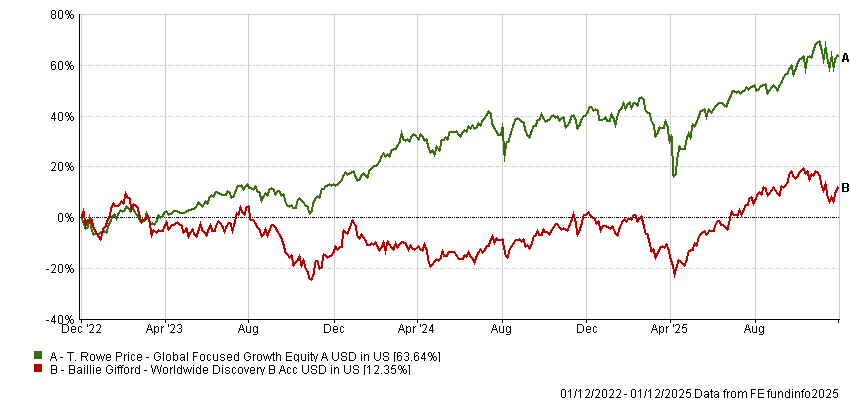
The Baillie Gifford fund has generated a three-year cumulative return of 12.35%, with annualised volatility of 22% and an information ratio (a measure of risk-adjusted returns) of -0.61, according to FE fundinfo
The TRP strategy has performed more strongly during this period, achieving a three-year cumulative return of 63.64% as it rode the rally in large tech growth stocks. It has annualised volatility during the period of 16.27%, and boasts an information ratio of 0.71.
“The TRP fund is in favour, while the Baillie Gifford fund is facing several headwinds,” said McDermott.
Both are growth-led, but the TRP fund has benefitted from the success of the technology behemoths in recent years, with names like Nvidia, Microsoft, Apple, Alphabet, TSMC, Meta, Amazon and Broadcom – all in its top 10 holdings. The portfolio has delivered double-digit returns in six of the past seven years (the only outlier being 2022, when the fund fell 30%).
“By contrast, the small-cap nature of the Baillie Gifford fund has meant it is on the outside looking in at the success of its larger peers, said McDermott.
Rate rises have hit particularly hard, with the fund falling in 2021 and 2022, and in the past three years, it has delivered modest positive returns as small-caps deal with a changing landscape.
“However, it is important to remember that this fund can deliver exceptional returns when markets are in its favour. For example, it returned almost 80% to investors in 2020 – hence why it is not for the fainthearted,” McDermott said.
Discrete calendar year performance
| YTD* | 2024 | 2023 | 2022 | 2021 | 2020 | |
| Baillie Gifford | 17.93% | -3.57% | 5.22% | -42.04% | -22.04% | 80.54% |
| TRP | 18.72% | 16.74% | 25.52% | -29.62% | 8.67% | 49.83% |
| Sector# | 16.05% | 9.83% | 17.19% | -20.83% | 14.25% | 17.17% |
Manager review
Both asset managers are leading houses in growth investing, with large analyst support groups behind their respective managers, according to McDermott.
Douglas Brodie joined Baillie Gifford in 2001 and became a partner in 2015. He graduated with a BSc in Molecular Biology and Biochemistry from the University of Durham in 1997 and attained a DPhil in Molecular Immunology from the University of Oxford in 2001.
He is joined in the portfolio management team at Baillie Gifford by investment managers Svetlana Viteva and John MacDougall.
David Eiswert is a portfolio manager at TRP, overseeing the Global Focused Growth Equity strategy since October 2012. He previously managed the Global Technology strategy from 2008 to 2012 and worked as a technology analyst from 2003 to 2012. With 19 years of investment experience, Eiswert has been with TRP for 16 years.
Before joining the firm, he worked as an analyst at Mellon Growth Advisors and Fidelity Management and Research, and as a consultant in communications. David holds a B.A. in Economics and Political Science from St. Mary’s College of Maryland and an M.A. in Economics from the University of Maryland. He is a Chartered Financial Analyst.
Conclusion
“McDermott “has to side with the TRP fund at this moment in time, particularly given the consistency of performance”.
“As with all TRP funds, the role of the analyst in seeking out the right candidates for further scrutiny is key,” he added, and Eiswert uses their best ideas and builds a portfolio based on key themes “to create a global equity fund with considerable potential for delivering long-term returns across all market conditions”.
However, McDermott could also make a case for the TRP fund being a “core strategy” and the Baillie Gifford Worldwide Discovery fund “complementing it”.
“Performance has been challenging recently, but investors with patience could easily be rewarded with incredibly strong returns once markets become more favourable for smaller companies. When performance does turn, I expect it will do so sharply,” McDermott concldued.