


“What are you going to encourage your kids to study, so they have a chance of a job?” was the question posed by a so-called “futurist” in a closed-door session this week, to which Spy was given observer status. “With AI killing entry-level jobs and automation eliminating everything else, what are they going to do?” There was an almost moral panic around the debate with apocalyptic tones for the future of the job market, especially for the youth. Yet, the optimists in the room pointed out that since the industrial revolution in the late 1700s to the nascent robotic transformation of factories in the 1960s and personal computer earthquake of the1980s, the media has always predicted a jobs apocalypse, which ultimately fails to materialise, as humans adapt rapidly. The big question is: is this time different? Ah, there is the rub, notes Spy.
Asset managers have been providing ways to give investors regional and sectoral exposure for decades. This week, BlackRock’s iShares has gone one step further down than country exposure and released the first ETF concentrating exclusively on companies headquartered in a single American state: Texas. Spy can’t help but think there is a political angle here. BlackRock suffered a backlash from conservative lawmakers that despised the company’s ESG focus. The iShares Texas Equity ETF (TEXN) must go some way to appeasing that noisy rabble. To be fair, Texas has one of the strongest local economies; its real GDP grew at an annual rate of 3.5% in the fourth quarter of 2024, exceeding the national average of 2.4%. In the US, the state is seen as particularly corporate-friendly and dynamic. For those people who know America’s voting vernacular, the question is: will the Fat Lady sing, or at least outperform?
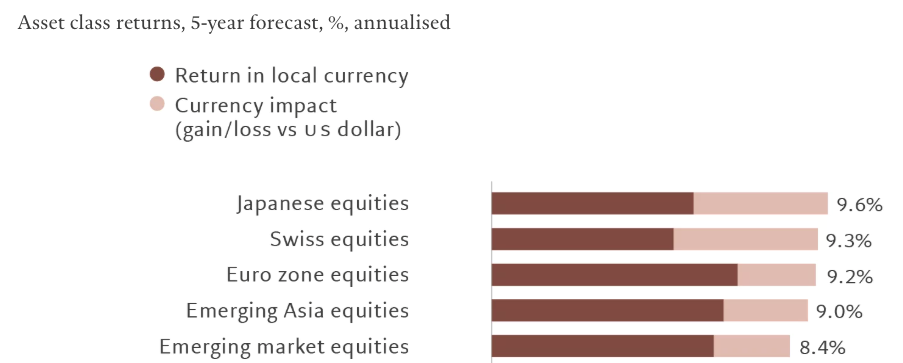
Active asset managers like to think they can make predictions on the future with their deep pool of highly qualified portfolio managers and super smart analysts. Their track records are usually rather abysmal when held up to the real world, but nonetheless Spy is rather pleased they continue to put their heads above the parapet from time to time. Pictet has just published its guesses on the best performing assets over the next five years which is worth reading in full. On the equity front, the Swiss manager is expecting Japan equity, Swiss equity and Euro zone equities to be top three performers with EMEA, US and frontier markets at the bottom of the equity list. Interestingly, Pictet expects private equity to be single best asset class overall, with hedge funds at the bottom of the list in the alternatives category. Within fixed income, emerging markets local currency bonds are their top pick.
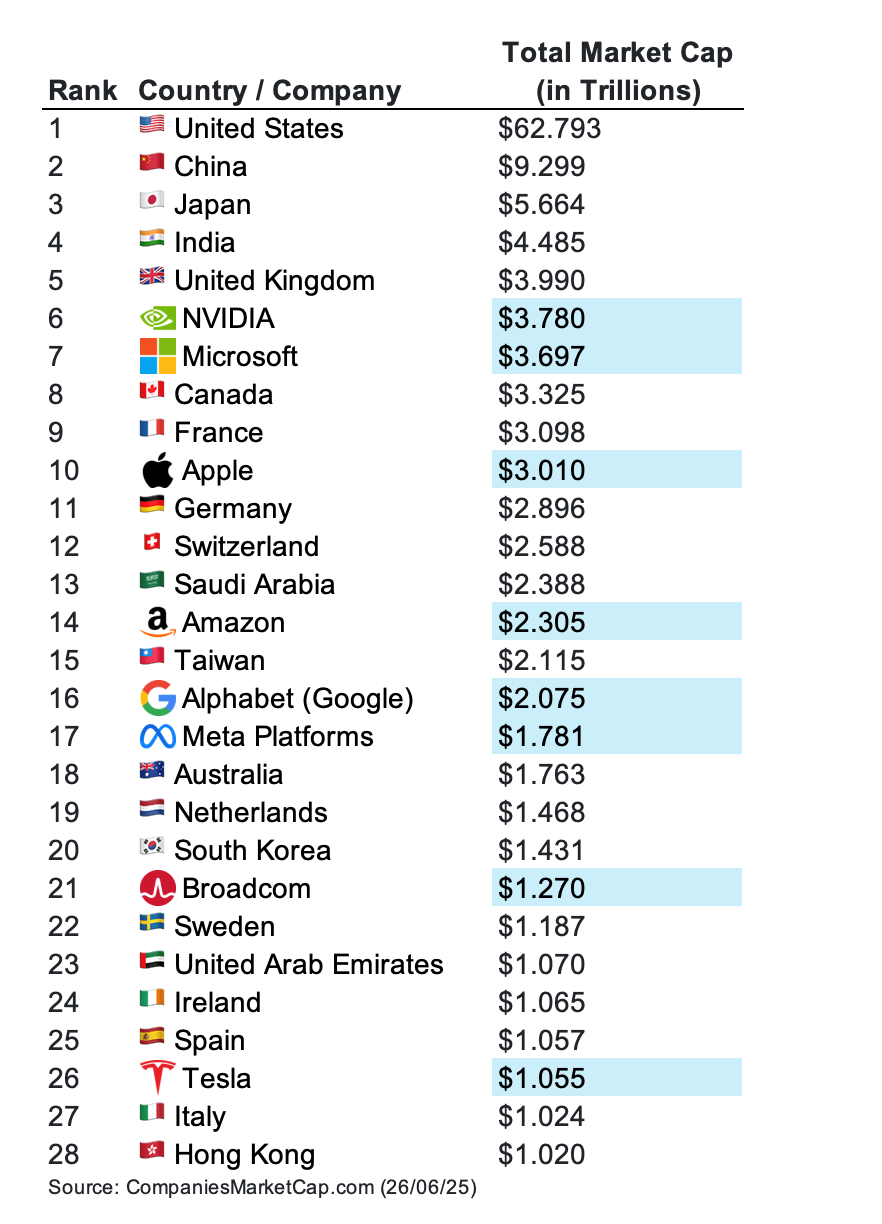
During yesterday’s trading session, Nvidia’s market capitalisation briefly went through $3.8trn. This got Spy thinking: how many markets and stocks could you buy instead of Nvidia for that vast sum of money? It turns out, an awful lot. Spy ranked the top twenty global stock markets by total market capitalisation and ranked them against America’s eight most valuable companies. The results are intriguing. Only the top five markets: the US, China, Japan, India and the UK are worth more than Nvidia and Microsoft respectively. Canada and France currently just pip Apple, which has faltered in its AI efforts. Even Tesla, with its wild volatility, is currently exceeded by only 18 different markets. Either the rest of the world is very undervalued, or these eight companies are worth too much, in Spy’s humble opinion.
Visitors to Singapore who return to London, Paris or New York, typically regale their friends and colleagues on how utterly modern the city is and how brilliant its infrastructure is. All very true. The rest of the world needs to pay catch up and Aberdeen Investments has put a number against that requirement, and it is a jaw-droppingly massive one. In a research piece, the Scottish manager estimates, “From roads and railways to energy grids and broadband, the world faces a $64trn infrastructure challenge.” That is the amount of cash that is needed to modernise failing infrastructure in developed markets and build needed capacity in emerging ones. Even if the world achieves half of that, we can all be optimistic that investment will flow.
China increasingly dominates the global gold trade, with its own mines and a central bank enthusiastic for the precious metal, too, notes Spy. This week, the Shanghai Gold Exchange (SGE) launched its first offshore vault for physical gold delivery in Hong Kong, marking a strategic step to boost international engagement and strengthen, even further, China’s influence in the global market. Run by Bank of China, the new facility plays a key role in aligning China’s gold market with the international financial system. By enabling physical settlement in a major global financial hub, the SGE aims to enhance the attractiveness of its yuan-denominated contracts and improve cross-border liquidity. Meanwhile, the West prints money day in, day out.
Facts that make Spy go hmmm: There are now over 500,000 new homes for sale in the United States. This happens to be the most since November 2007. The main reason for rising home inventories is the same as it was eighteen years ago: a lack of affordability, which has caused demand to plunge. History does not repeat, but it rhymes.
Spy’s quote of the week is age-old wisdom by Anita Blackmon, “The quickest way to get rid of people, is to lend them money.” Cynical but probably true. Spy’s caveat: this does not work for mothers-in-law…he has tried it.
Until next week…