Barings eyes blended route to unlock EM debt potential
Emerging market (EM) debt is more diverse and higher quality than many investors think, via a flexible approach to sovereign, corporate and local currency bonds, according to Barings.


Emerging market (EM) debt is more diverse and higher quality than many investors think, via a flexible approach to sovereign, corporate and local currency bonds, according to Barings.
Emerging market (EM) debt is more diverse and higher quality than many investors think, via a flexible approach to sovereign, corporate and local currency bonds, according to Barings.

T. Rowe Price and Natixis IM are maintaining overweights to equities as earnings provide support.

Asian estate investment trusts (REITs) lack the exposure to high-growth sectors that has helped their US counterparts withstand rising interest rates, according to Jen-Ai Chua.
Asian estate investment trusts (REITs) lack the exposure to high-growth sectors that has helped their US counterparts withstand rising interest rates, according to Jen-Ai Chua.

Small and mid-market buyouts, asset-based finance and infrastructure debt are key areas to help investors navigate an uneven recovery in private markets, according to Nils Rode, Schroders Capital’s chief investment officer.
Sponsored by Loomis Sayles & Natixis
The Growth Equity Strategies Team at Loomis Sayles, an affiliate of Natixis Investment Managers, demonstrates that patience, discipline and conviction result in consistent, peer-leading risk-adjusted compounding over cycles.
Asian estate investment trusts (REITs) lack the exposure to high-growth sectors that has helped their US counterparts withstand rising interest rates, according to Jen-Ai Chua.
Small and mid-market buyouts, asset-based finance and infrastructure debt are key areas to help investors navigate an uneven recovery in private markets, according to Nils Rode, Schroders Capital’s chief investment officer.
Emerging market (EM) debt is more diverse and higher quality than many investors think, via a flexible approach to sovereign, corporate and local currency bonds, according to Barings.
Emerging market (EM) debt is more diverse and higher quality than many investors think, via a flexible approach to sovereign, corporate and local currency bonds, according to Barings.
T. Rowe Price and Natixis IM are maintaining overweights to equities as earnings provide support.
This week, FSA compares the T. Rowe Price Global Government Bond fund and the Amundi Global Government Bond fund.
This week, FSA compares the T. Rowe Price Global Government Bond fund and the Amundi Global Government Bond fund.

This week FSA compares two European equities funds: BlackRock GF European Value fund and the JPMorgan Europe Dynamic fund.

The launch comes two weeks after launching an optical communication ETF.
The launch comes two weeks after launching an optical communication ETF.

The shift towards higher interest rates is creating opportunities for selective exposure to financial stocks, says Min Zeng.
This week FSA compares the Schroder ISF US Small and Mid-Cap fund and the Capital Group Investment Company of America fund.


This week, FSA asked Darius McDermott (pictured), managing director of Chelsea Financial Services, to select two strong performing US equities strategies. He chose the Schroder ISF US Small and Mid-Cap fund and Capital Group Investment Company of America fund.
Managed in New York by Robert Kaynor and Joanna Wald, the Schroder fund has a focus on small and medium-sized companies, with a diversified set of return drivers, to dampen the risk of the overall portfolio. During the past three years, the fund has returned 40.49% to investors, according to FE fundinfo.

The Capital Group Investment Company of America fund is a core US equity strategy investing in a diversified portfolio of companies representing a cross-section of the American economy. The strategy has navigated multiple market cycles since its launch in 1933. Managed using Capital Group’s multi-manager approach since 1958, the fund aims to deliver long-term capital growth and income through disciplined, bottom-up stock selection. It has returned 77.21% during the past three years, according to FE fundinfo.
| Capital Group | Schroders | |
| Size | $1.88bn | $782m |
| Inception | 2016 | 2004 |
| Managers | Capital Group team | Robert Kaynor, Joanna Wald |
| Three-year cumulative return | 77.21% | 40.49% |
| Three-year annualised return | 21.36% | 11.63% |
| Three-year annualised alpha | 1.24% | 0.28% |
| Three-year annualised volatility | 14.53% | 15.95% |
| Three-year information ratio | 0.56 | -0.18 |
| FE Crown fund rating | **** | ** |
| OCF | 1.45% | 2.44% |
The Schroder fund invests in three different types of companies: “steady eddies” or less cyclically sensitive stocks act as ballast in the portfolio; “mispriced growth” stocks where managers Kaynor and Wald feel the market has not fully understood the company’s earnings potential; and, the smallest bucket, “recovery-type” situations, according to McDermott
“Kaynor and his team are valuation-sensitive and seek to be disciplined in both buying and selling. They look to identify ideas that potentially have a compelling investment thesis,” McDermott said.
These ideas may come from a variety of sources including company management, competitors, suppliers or the media. Screens may also be run to ensure that the team has not overlooked any companies with compelling metrics.
“Areas of focus include historical cash flows and free cash flow generation, cash flows relative to debt levels, historical revenue and sales growth, gross and operating margin analysis, profitability levels, return on assets, return on equity, earnings per share growth, debt levels, fixed asset levels/depreciation, cash levels, goodwill and accounts receivable/payable,” he said.
Capital Group’s investment process is founded on the belief that fundamental, bottom-up research is the key to superior long-term investment returns and that a company’s long-term earnings and dividend potential, rather than short-term market sentiment, ultimately drives its share price.
“Rather than relying on a single decision-maker, the fund is managed using the firm’s long-established multi-manager approach, where seven experienced portfolio managers independently invest in their highest-conviction ideas. Around 20% of the portfolio is also managed by the firm’s research analysts, giving them the opportunity to invest in the companies they know best,” said McDermott.
Ideas are generated through Capital Group’s extensive global research network and each manager constructs their own portion of the portfolio independently, creating a diversified blend of investment styles and ideas rather than relying on a single investment view.
“The result is a broad portfolio of high-quality companies from across the US market, designed to deliver long-term capital growth and income while remaining resilient across different market environments,” McDermott said.
“The obvious difference is the Capital Group has a focus on larger companies, while the Schroder fund invests further down the market-cap scale,” he added. “We can see the big tech players dominate the top 10 holdings in the Capital Group fund, with names like Nvidia, Microsoft, Broadcom and Amazon. Technology and communication companies account for about 45% of the portfolio.”
Schroder looks further down the market-cap spectrum for companies that could become tomorrow’s larger businesses.
“That translates into a very different and diversified portfolio, with industrials the largest sector exposure. There is reasonable exposure to technology (although not the tech giants), financials, consumer discretionary and healthcare.”
The Schroder fund has higher volatility and concentration risk (84 holdings), according to McDermott.
“This should make sense, given that mid-caps can be more economically sensitive and less resilient than the largest US companies. Capital Group’s approach is deliberately more diversified – positioning as a balanced core allocation designed to provide multiple sources of return and some downside resilience.”
McDermott noted that the Schroder fund’s largest positions tend to be less than 25%, while the Capital fund has 6% or more in some of those larger tech names**.
“The other main difference has to be the approach; Schroder has two lead managers supported by a team of analysts, while Capital Group has chosen to go down the multi-manager route with seven managers and 230 analysts behind the process,” he said.
Fund characteristics
Sector allocation:
| Capital Group | weighting | Schroders | weighting |
| Energy | 1.5% | Industrials | 28.3% |
| Materials | 2.4% | IT | 16.6% |
| Industrials | 10.8% | Financials | 13.3% |
| Consumer discretionary | 11.8% | Consumer discretionary | 12.5% |
| Consumer staples | 1.9% | Healthcare | 10.6% |
| Healthcare | 8.9% | Materials | 5.3% |
| Financials | 7.7% | Energy | 4.1% |
| IT | 35.3% | Real estate | 4.0% |
| Communication services | 12.3% | Liquid assets | 3.3% |
| Utilities | 2.6% | Utilities | 2.0% |
| Real estate | 1.7% |
Top 10 Holdings:
| Capital Group | weighting | Schroders | weighting |
| Nvidia | 7.4% | Repligen | 2.6% |
| Microsoft | 6.9% | ICU Medical | 2.3% |
| Broadcom | 5.9% | Assurant | 2.0% |
| Amazon.com | 5.4% | Novanta | 1.8% |
| Alphabet | 5.0% | Reinsurance Group of America | 1.7% |
| Meta Platforms | 3.9% | Zebra Technologies | 1.7% |
| Eli Lilly | 2.6% | TechnipFMC | 1.6% |
| TSMC | 2.6% | Balchem | 1.6% |
| Intel | 2.2% | Hexcel | 1.5% |
| Uber | 2.1% | AptarGroup | 1.5% |
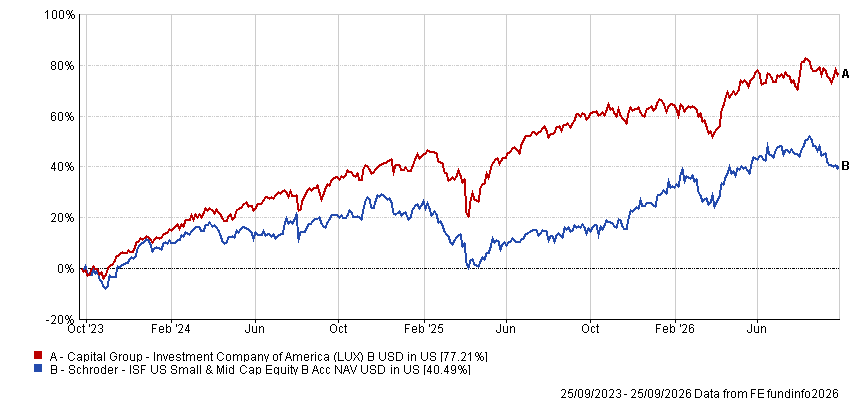
The Capital Group fund has performed better during the past three years.
“It should be noted that some of this is due to the enormous earnings and share-price gains of the US mega-cap winners. However, it is a diversified portfolio with money spread across growth, cyclical and income-paying businesses. One underlying manager can hold those leading tech names, while another could hold more defensive positions,” McDermott said.
The success of this diversification is highlighted by the fact it has outperformed the S&P 500 over five years (71.3% vs. 59.6%). That diversification has helped in more challenging years.
“The Schroder fund simply cannot compete with the earnings of some of those large-cap tech/AI-driven names,” said McDermott. “There have been some stock selection challenges in recent years for the Schroder fund; but, I would also point to the three chief investment buckets (mispriced growth, steady eddies and turnarounds) resulting in the creation of a more fundamentally-driven, quality-conscious portfolio.”
“The problem is that parts of the small and mid-cap market have periodically been driven by almost the opposite characteristics: speculative, high-beta, low-profitability companies. This has led to it underperforming its benchmark which will have more of those speculative winners.”
However, a shift away from AI-led companies and a greater focus on earnings and cash flows have seen the fund improve recently.
“Both are asset managers are market leaders and have huge research teams,” said McDermott.
Robert Kaynor officially became co-manager on this fund in January 2018 but has been recognised as such since 2014, when he was appointed director of small- and mid-cap research. He took full charge in March 2019. Prior to joining Schroders, he was chief investment officer at Ballast Capital Group and managing director and portfolio manager at Ramius Capital Group. Joanna Wald became co-manager in 2025.
The Capital Group fund is run by seven portfolio managers, including Jim Lovelace (44 years at Capital Group), Martin Romo (33), Chris Buchbinder (30) and Grant Cambridge (29), with each bringing independent investment ideas through Capital’s multi-manager “Capital System.”
“They are backed by more than 230 sector and regional analysts, plus fundamental research associates, economists and quantitative teams; importantly, Capital Group also allocates part of the fund to its research analysts to manage themselves, so the analyst team contributes directly to the portfolio rather than simply providing research to the managers,” McDermott said.
The Capital Group fund has an ongoing charge of 1.45%, while the Schroder fund is more expensive at 2.44%, according to to FE fundinfo data.
“The two US funds are doing very different things,” McDermott said.
“I would side with the Capital Group fund as a core holding with exposure to mega-cap winners, broad diversification and strong historical stock selection. This is supported by consistently strong performance.”
“But Schroders is not positioning itself as a core fund in my eyes; it is an active small- to mid-satellite that works in tandem with a core holding,” McDermott said. “You get exposure that Capital Group cannot offer and a potential greater upside if the market broadens beyond technology. The manager’s style has also been challenged and should benefit from a return to fundamentals. You just have to accept greater risk and periods of underperformance.”.
“The Schroders strategy is a nice alternative for US equities if we see a change in market dynamics,” McDermott concluded.
The launch comes two weeks after launching an optical communication ETF.
Asian estate investment trusts (REITs) lack the exposure to high-growth sectors that has helped their US counterparts withstand rising interest rates, according to Jen-Ai Chua.

Expresses preference for shorter-term or inflation-linked bonds.