Fidelity sees further upside in Japanese banks as rates rise
The shift towards higher interest rates is creating opportunities for selective exposure to financial stocks, says Min Zeng.


The shift towards higher interest rates is creating opportunities for selective exposure to financial stocks, says Min Zeng.
The shift towards higher interest rates is creating opportunities for selective exposure to financial stocks, says Min Zeng.

The partnership will see Hamilton Lane funds available on the Chubb Wealth platform for eligible Hong Kong investors.
The partnership will see Hamilton Lane funds available on the Chubb Wealth platform for eligible Hong Kong investors.
The partnership will see Hamilton Lane funds available on the Chubb Wealth platform for eligible Hong Kong investors.

It aims to generate income that includes senior direct lending, credit secondaries, fund financing, royalties, opportunistic credit, and liquid credit.
Sponsored by Loomis Sayles & Natixis
The Growth Equity Strategies Team at Loomis Sayles, an affiliate of Natixis Investment Managers, demonstrates that patience, discipline and conviction result in consistent, peer-leading risk-adjusted compounding over cycles.
The partnership will see Hamilton Lane funds available on the Chubb Wealth platform for eligible Hong Kong investors.

Equity earnings momentum needs to offset rising bond yields, according to multiple chief investment officers (CIOs).
The shift towards higher interest rates is creating opportunities for selective exposure to financial stocks, says Min Zeng.
The shift towards higher interest rates is creating opportunities for selective exposure to financial stocks, says Min Zeng.

Liquidity and concentration concerns.

This week FSA compares two European equities funds: BlackRock GF European Value fund and the JPMorgan Europe Dynamic fund.
This week FSA compares two European equities funds: BlackRock GF European Value fund and the JPMorgan Europe Dynamic fund.

Advisers in Asia are committing to alternatives at a time of markedly lower confidence, the survey found.
The shift towards higher interest rates is creating opportunities for selective exposure to financial stocks, says Min Zeng.
The shift towards higher interest rates is creating opportunities for selective exposure to financial stocks, says Min Zeng.

Seviora Capital is integrating with Azalea and SeaTown to create a new combined asset manager.
Dorian Carrell, head of multi-asset income at Schroders, bases his balanced strategy on three pillars.

Traditional 60/40 balanced strategies have struggled to deliver risk-adjusted returns and diversification as stock-bond correlations turn positive. One popular solution is to allocate a portion of a portfolio to alternative investments, such as private markets and hedge funds.
Dorian Carrell, head of multi-asset income at Schroders, has a different solution.
“Our approach is based on three pillars: consistent income from global fixed income, a convertible bond anchor, and blended growth and income from equities. The strategy is designed to address the limitations of the traditional 60/40 benchmark, particularly in a prolonged high-interest-rate environment driven by persistent inflation,” Carrell told FSA in an interview.
“The US Federal Reserve has not met its inflation target for 65 months, and we expect this trend to continue, shaping the investment landscape for years to come.”
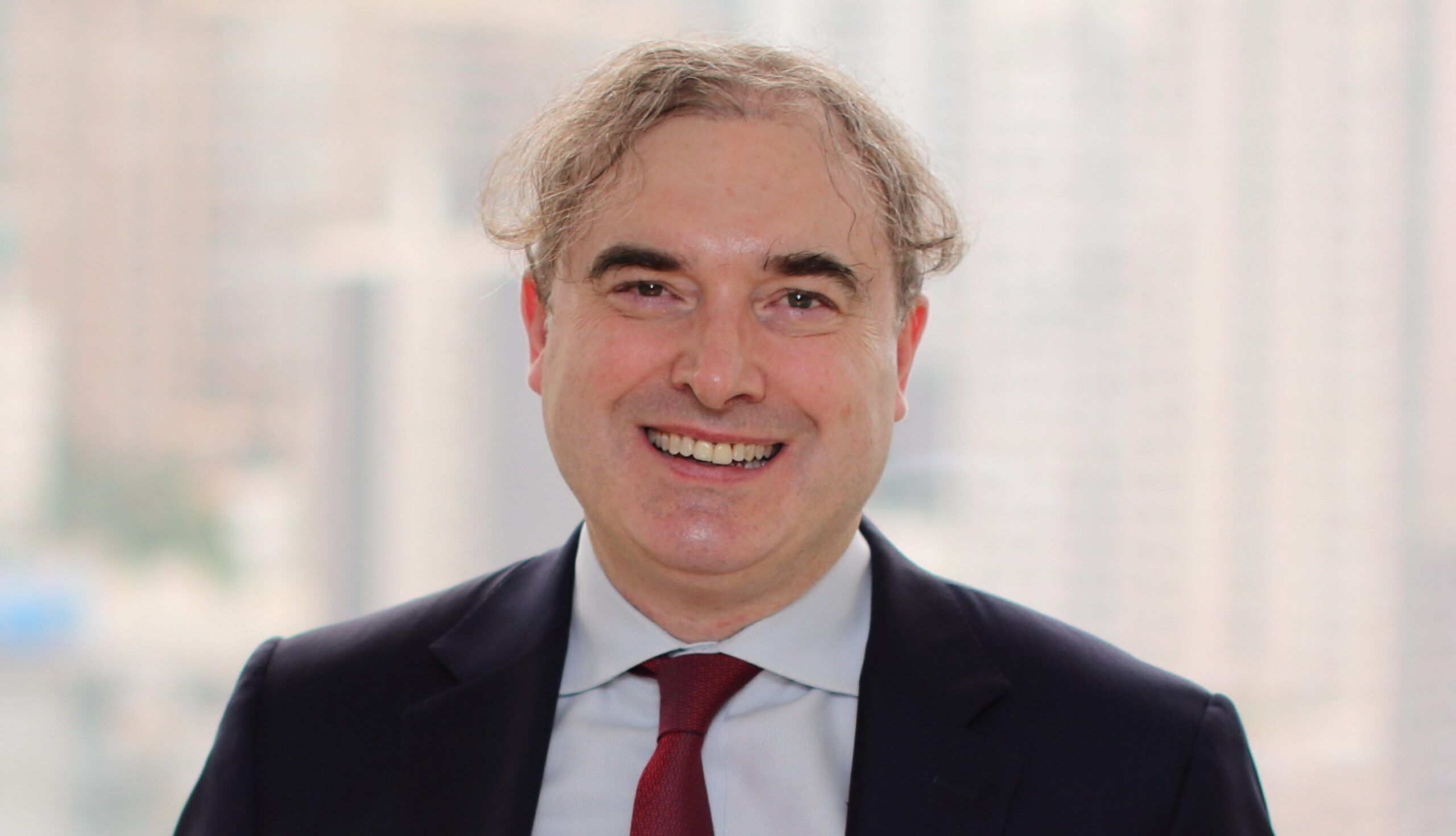
Carrell (pictured) has co-managed with Remi Olu-Pitan the $4.06bn Schroder Multi-Asset Growth and Income fund since September 2018. It is authorised by the Hong Kong Securities and Futures Commission and recognised by the Monetary Authority of Singapore for sale to retail investors. It is rated four-stars by Morningstar and five-crowns by FE fundinfo.
The fund aims to deliver an income of 3-5% per annum and provide capital growth before fees have been deducted over a three-to-five-year period by investing in a diversified range of assets and markets worldwide, according to fund information.
“Within each pillar, we maintain flexibility. Allocations typically range from 25% to 35% per pillar, but we actively manage exposures,” Carrell said.
The strategy has generated a three-year cumulative return of 53.79%, with alpha of 3.34%, compared with a 36.44% return by its sector average, according to FE fundinfo data. Its annualised volatility over the same period (to 11 September 2026) is 9.25%, slightly higher than the sector’s 7.74%.
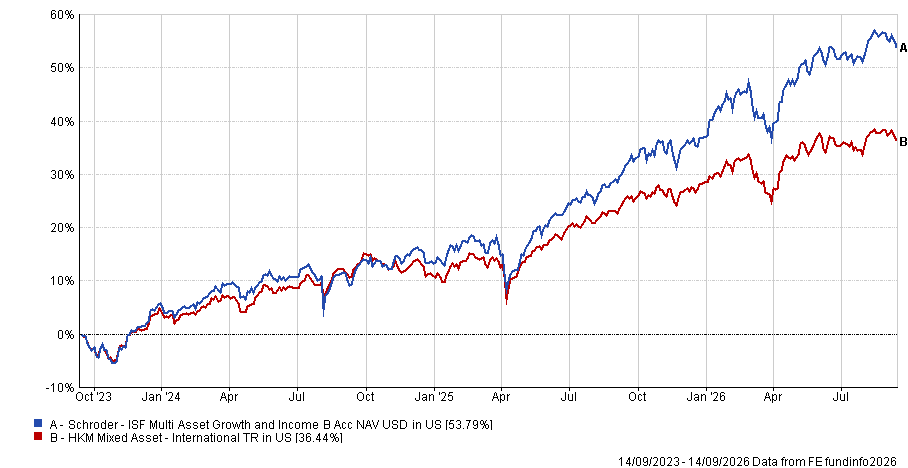
The strategy has also achieved a 15.19% return during the past 12 months, FE fundinfo data shows.
Bonds for stability
In fixed income, the strategy currently has no US or European investment grade or treasury exposure. Historically, it has held about 20% in US high yield. However, its focus is now on maximizing credit quality while minimizing sensitivity to US interest rates, using combinations such as 7.5% in agency-backed securities and 5% in non-agency bonds.
“We currently allocate approximately 5–6% to European high yield, which we believe offers better credit quality and lower rate sensitivity. We also hold Australian investment grade bonds, which provide higher yields and less interest rate sensitivity compared to US investment grade,” said Carrell.
Additionally, 10% of the portfolio is in emerging market local currency bonds, primarily in Brazil, South Africa, Mexico, and Colombia, allowing the strategy to capture high real yields while mitigating currency risk.
“Fixed income’s primary role is to provide steady income and stability, though it currently offers limited diversification due to positive correlations between risky and safe assets,” Carrell said.
“We focus on credit quality and generally keep portfolio duration under seven years, with no US duration and a preference for Australian and local bonds. Our target yield is 5% with investment grade holdings, and we actively adjust duration based on interest rate expectations.”
Equities enhanced with covered calls
For equities, the managers use a top-down approach. “Our core portfolio, managed by a dedicated team, focuses on growth and income and represents about 15% of the fund,” Carrell said.
“We supplement this with thematic baskets based on research, targeting sectors such as commodities, energy, and industrial metals.”
The equity portfolio yields approximately 2.8%, which is enhanced through covered call writing based on fundamental analysis. Calls are only sold above fair value, distinguishing the approach of strategies that focus on volatility. This increases the yield from about 2% to 5%, though call overwriting contributes only 0.2% to the fund’s overall 5.2% yield.
The strategy is also currently invested in European, US, and Japanese banks for different strategic reasons.
“European banks are attractive due to low price-to-earnings ratios and strong shareholder yields. US bank exposure is driven by capital markets activity and regulatory changes, while Japanese banks benefit from a steepening yield curve,” Carrell said.
In industrials, the equity basket is diversified across Japan, Europe, and the US, with Japanese industrials trading at significant discounts. In technology, it is underweight at 21% compared with the benchmark, primarily due to limited exposure to software. The strategy also maintains a 2–3% position in gold as a hedge against dollar weakness.
Convertibles offer value
Convertibles comprise about 31% of the portfolio with US convertibles and Asian convertibles in the mix.
“The Asian convertible market is attractive due to limited competition and favourable valuations, particularly in semiconductor and technology companies. We do not convert to equity, adhering to a strict policy. The convertible market remains liquid, with various participants providing depth,” said Carrell.
“Performance since launch has been strong, particularly over the past 12 months. Most of the returns have come from US equities and convertibles, with fixed income contributing 2.5% in the last year. The strategy has outperformed both 60/40 benchmarks and competitors,” he said.
Equity earnings momentum needs to offset rising bond yields, according to multiple chief investment officers (CIOs).
It aims to generate income that includes senior direct lending, credit secondaries, fund financing, royalties, opportunistic credit, and liquid credit.
Seviora Capital is integrating with Azalea and SeaTown to create a new combined asset manager.