Fed expected to pause rate hikes despite hot inflation
AllianzGI, Allspring and BlackRock predict a delay in rate hikes at the next Fed meeting, but not an end to monetary tightening.

AllianzGI, Allspring and BlackRock predict a delay in rate hikes at the next Fed meeting, but not an end to monetary tightening.
AllianzGI, Allspring and BlackRock predict a delay in rate hikes at the next Fed meeting, but not an end to monetary tightening.
Robeco’s value manager Wim-Hein Pals took profits in tech when the market “was going ballistic”.
The abrdn SICAV I – Diversified Income fund is available under Prudential’s investment-linked assurance scheme in Hong Kong
The abrdn SICAV I – Diversified Income fund is available under Prudential’s investment-linked assurance scheme in Hong Kong

The global private markets firm said it raised significant commitments from investors in Asia and the Middle East.
Sponsored by Loomis Sayles & Natixis
The Growth Equity Strategies Team at Loomis Sayles, an affiliate of Natixis Investment Managers, demonstrates that patience, discipline and conviction result in consistent, peer-leading risk-adjusted compounding over cycles.
AllianzGI, Allspring and BlackRock predict a delay in rate hikes at the next Fed meeting, but not an end to monetary tightening.
The abrdn SICAV I – Diversified Income fund is available under Prudential’s investment-linked assurance scheme in Hong Kong
AllianzGI, Allspring and BlackRock predict a delay in rate hikes at the next Fed meeting, but not an end to monetary tightening.
AllianzGI, Allspring and BlackRock predict a delay in rate hikes at the next Fed meeting, but not an end to monetary tightening.
Robeco’s value manager Wim-Hein Pals took profits in tech when the market “was going ballistic”.

Hong Kong and Singapore investors are more comfortable with their choices and are guided by professional advisers.
Hong Kong and Singapore investors are more comfortable with their choices and are guided by professional advisers.
This week, FSA compares the Invesco US Value Equity Fund and the Harris Oakmark U.S. Value Equity Fund.
Robeco’s value manager Wim-Hein Pals took profits in tech when the market “was going ballistic”.
Robeco’s value manager Wim-Hein Pals took profits in tech when the market “was going ballistic”.
Hong Kong and Singapore investors are more comfortable with their choices and are guided by professional advisers.
Robeco’s value manager Wim-Hein Pals took profits in tech when the market “was going ballistic”.

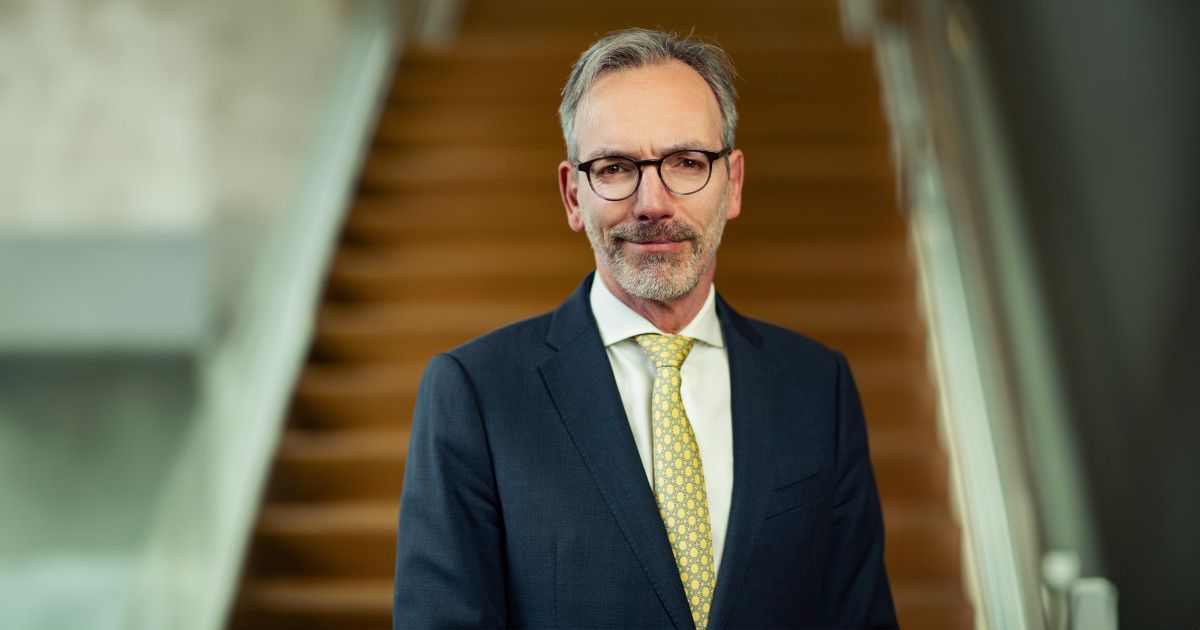
After a historic rally in South Korean equities, Robeco’s Wim-Hein Pals (main picture) still sees value in the market and is maintaining an overweight stance.
This comes after going “maximum overweight” in late 2024 before a dizzying rally in the South Korea’s equity market, driven largely by index heavyweights Samsung and SK Hynix.
Pals, who is head of emerging markets equities at Robeco and lead manager of its $1.7bn emerging markets equities fund, told FSA in an interview he has been selectively buying back into Korean equities after selling before the recent deleveraging in the market.
“We took a lot of profits in the Korean and Taiwan tech sector early this year, rebalancing in these names when the market was going ballistic,” he said. “We’ve been buying back selectively, but not as much as before. We still like the Korea discount.”
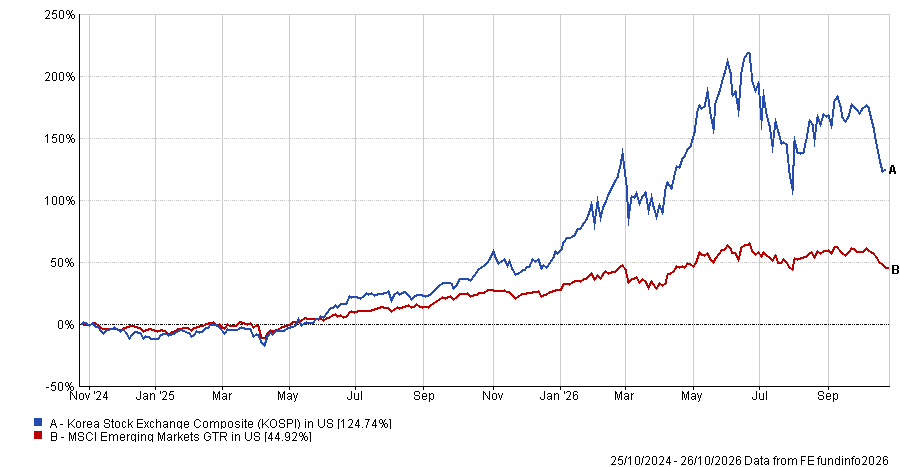
The Korea Stock Exchange Composite (Kospi) is up 124.7% during the past two years, compared with 44.9% from the wider MSCI Emerging Markets index.
Despite widespread attention on the blockbuster profits being generated by the country’s technology sector, Pals said the country’s valuation discount is still persistent.
South Korean equities have long traded at a discount to global peers due to its history of weak shareholder returns, opaque “chaebol” governance and geopolitical risks.
Pals said: “The Korea discount is still there, which must disappear over the next few years, although it won’t disappear overnight: the value up programme in that sense was unsuccessful because there is still a discount.”
South Korean authorities have made efforts to change corporate governance behaviour in the same way Japan has tried to, and Pals has observed some changes.
He said: “There is much more focus on capital returns, shareholder value in all the Korean corporations I speak to; increasing the dividend payout ratio, buybacks and cancelling the shares, is top of the agenda.”
“It’s across the board, across all sectors, and most companies. The ones that don’t will be left out and listed out. The government will name and shame.”
Pals is less optimistic on Indian equities and Chinese equites, however, due to a weak macroeconomic backdrop in both regions.
With regards to India, he says the nation faces some macroeconomic challenges in the form of interest rate hikes, stubbornly high inflation and a growing fiscal deficit.
“India continues to do well, corporations are much more optimistic and confident, but valuations are still outrageous,” he said, re-iterating his underweight position to the region.
When it comes to China, despite lower valuations, the macro backdrop is also challenged, according to Pals.
The world’s second largest economy faces weak domestic demand, lingering effects from its property crisis, deflationary pressures and rising reliance on exports.
“The consumer in China is very, very slow,” Pals said. “There are no triggers to speed it up. Exports are firing on all cylinders, but consumption is going nowhere. I spoke to several consumption-related companies, and they are not optimistic at all.”
Pals said he has been underweight China equities for some time now, but after a recent visit to the region he feels “no urgency to go from an underweight to overweight anytime soon”.
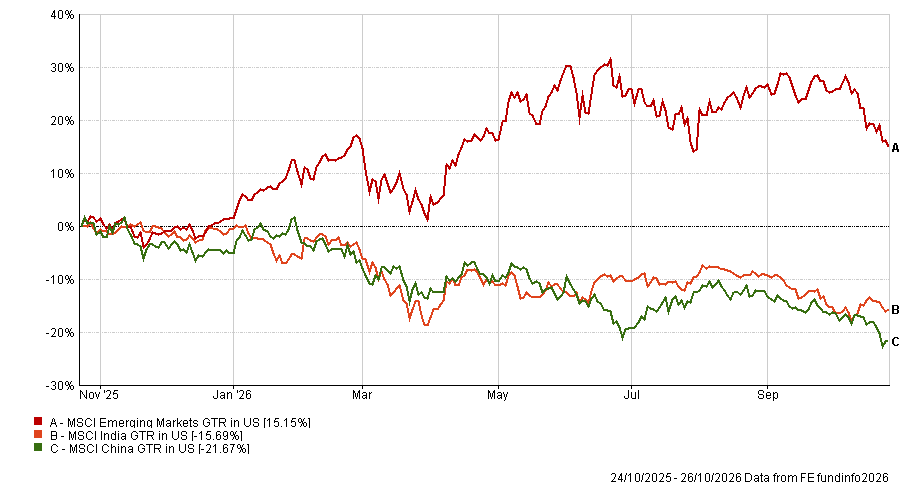
Both Chinese and Indian equities have lagged the MSCI Emerging Markets index over the past twelve months, down 21.6% and 15.7% respectively, compared with a 15% gain from the wider benchmark.

Yield+ invests in three actively managed funds.
Azril Ikram joins the Singapore-based asset manager from Franklin Templeton.

The alliance aims to expand Taishin’s international private banking and investment services for wealthy clients in Taiwan.