Schroders builds out wealth team with hiring of family office veteran
Schroders Wealth Management has hired Sharon Sim as head of business development, Asia.


Schroders Wealth Management has hired Sharon Sim as head of business development, Asia.
Schroders Wealth Management has hired Sharon Sim as head of business development, Asia.

Yuvaara is cooperating with LifeDirect and Apeiron Group.

Brookfield Infrastructure income fund is available to wholesale investors in Australia’s private wealth market.
Brookfield Infrastructure income fund is available to wholesale investors in Australia’s private wealth market.

The ChinaAMC Digital Gold ETF will be backed by physical gold stored in Hong Kong vaults, marking the city’s first fully tokenised gold fund.
Sponsored by Loomis Sayles & Natixis
The Growth Equity Strategies Team at Loomis Sayles, an affiliate of Natixis Investment Managers, demonstrates that patience, discipline and conviction result in consistent, peer-leading risk-adjusted compounding over cycles.

This week FSA compares the First Sentier Global Listed Infrastructure fund and M&G Global Listed Infrastructure fund.
Brookfield Infrastructure income fund is available to wholesale investors in Australia’s private wealth market.
Schroders Wealth Management has hired Sharon Sim as head of business development, Asia.
Schroders Wealth Management has hired Sharon Sim as head of business development, Asia.

Large institutional asset owners identified concentration risk, sustainable investing and diversification as core themes for the year ahead.
This week FSA compares the First Sentier Global Listed Infrastructure fund and M&G Global Listed Infrastructure fund.
This week FSA compares the First Sentier Global Listed Infrastructure fund and M&G Global Listed Infrastructure fund.
Large institutional asset owners identified concentration risk, sustainable investing and diversification as core themes for the year ahead.
Schroders Wealth Management has hired Sharon Sim as head of business development, Asia.
Schroders Wealth Management has hired Sharon Sim as head of business development, Asia.
The ChinaAMC Digital Gold ETF will be backed by physical gold stored in Hong Kong vaults, marking the city’s first fully tokenised gold fund.
This week FSA compares the First Sentier Global Listed Infrastructure fund and M&G Global Listed Infrastructure fund.

FSA asked Darius McDermott, managing director of Chelsea Financial Services to compare two listed infrastructure funds. He chose the First Sentier Global Listed Infrastructure fund and the M&G Global Listed Infrastructure fund.
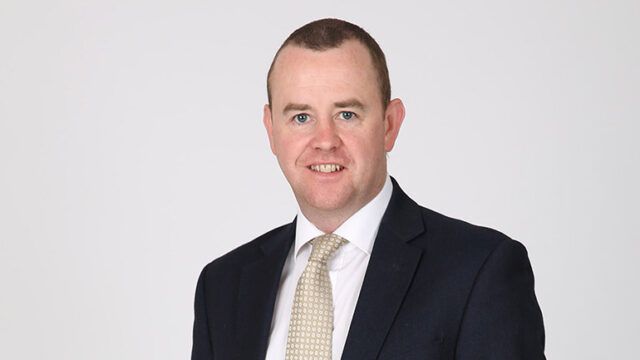
“There’s always something comforting about investing in a structural trend that goes beyond any political rhetoric,” McDermott said.
“Take Asia, for example, where the long-term trends are clear as the population and the middle class within it continue to grow, making it an attractive region for investors.”
“The same is true for infrastructure, whether it is roads, airports, hospitals, or schools; it is an essential element of modern society and the economy that needs major (and consistent) investment,” McDermott said.
As a low-beta defensive asset class, infrastructure investing is not new to retail investors. It also has a link to inflation because there are several regulatory, concession and contractual agreements that offer a degree of protection should inflation rise.
“Think of the likes of utilities, mobile towers and oil pipelines as examples. The asset class has also widened out to include the green and digital infrastructure, as well as royalties and Reits,” McDermott said.
He noted that the First Sentier Global Listed Infrastructure fund seeks to deliver income and some capital growth by investing in listed infrastructure companies around the world.
In fact, First Sentier Investors “was one of the pioneers in providing access to this asset class, which quickly captured the attention of income-focused investors”.
The fund invests in “hard” infrastructure such as bridges and ports around the world, via listed companies that own the assets.
Meanwhile, the M&G Global Listed Infrastructure fund looks for a balance of growth and income from three key areas of the sector: economic, social and “evolving” infrastructure.
“This means investments can include anything from utilities and toll roads to health, education and civil buildings, as well as mobile towers, data centres, payment companies and royalties.
| First Sentier | M&G | |
| Size | $870m | $1.59bn |
| Inception | 2008 | 2017 |
| Managers | Peter Meany, Andrew Greenup, Edmund Leung | Alex Araujo, Nicholas Cunningham, Son Tung Nguyen |
| Three-year cumulative return | 40.33% | 27.52% |
| Three-year annualised return | 9.57% | 7.06% |
| Three-year annualised alpha | -0.69% | -3.71% |
| Three-year annualised volatility | 12.70% | 13.05% |
| Three-year information ratio | 0.01 | -0.64 |
| FE Crown fund rating | *** | – |
| Morningstar medal | Neutral | Negative |
| OCF | 1.75% | 2.08% |
The First Sentier managers are conservative investors, recognising that capital preservation is critical to achieving long-term capital growth, according to McDermott. They focus on fundamental value and conduct thorough due diligence to minimise downside. Strong emphasis is placed on proprietary research and direct contact with companies and regulators.
They invest in real infrastructure assets with barriers to entry and pricing power, and aim to generate a yield of more than 3%.
“These ‘hard’ infrastructure assets include the likes of bridges and ports around the world, via listed companies that own the assets,” McDermott said. Of around 120 companies that the team has identified and monitor, 40 are included in the portfolio, comprising those that the managers believe can earn returns above consensus expectations.
Meanwhile, M&G Global Listed Infrastructure seeks to expand on the growing infrastructure universe as it searches for a balance of growth and income from three key areas of the sector: economic (65-75% of the portfolio including utilities, energy and transport); social (currently 7%) – including health, education and civic); and ‘evolving’ (15-25% including comms, logistics and royalty) infrastructure, according to McDermott.
“The fund takes a slightly different approach by diversifying away from utilities, energy and transport to a degree by investing greater amounts in areas like royalties, REITs, digitisation and exchanges,” McDermott said.
“Managed by Alex Araujo, the fund targets companies with critical physical infrastructure, long-term concessions or perpetual royalties.”
They will also need to be paying some level of dividend and have a market-cap of over $1bn. Valuations also play a key role, as does ESG and responsible stewardship.
“The major difference between the two strategies is in how they diversify exposure to infrastructure assets. Utilities have been the successful play in the infrastructure space in the past couple of years with most indexes holding around 50% in these companies alone,” said McDermott.
First Sentier currently has around 44% across electric, multi-utilities, gas and water utilities. It also has overweights versus its benchmark towards airport and highways and railtracks (see tables below)
M&G Global Listed Infrastructure is more diversified, with only 32% in utilities (a headwind for the portfolio in recent years). The exposures to energy and transport are closer to the FTSE Global Core 50/50 benchmark.
By contrast, it has material overweights to royalties, social and digital infrastructure. A good example of this is a name like Franco-Nevada, the gold- and copper-royalty owner. It is a big differentiator in that they have rights to land in the US and Canada and invite companies to mine on the land, taking a portion of royalties from them, according to McDermott
The other main difference of note is the First Sentier fund has a greater exposure to US equities (57.4% vs. 42%), while the M&G fund has greater exposure to Canada (17.5% vs. 4.3%) and the UK (10.9% vs. 5.2%), he noted.
Fund characteristics
Sector allocation:
| First Sentier | weighting | M&G | weighting |
| Electric Utilities | 23.8% | Utilities | 34.5% |
| Multi Utilities | 14.9% | Energy | 16.6% |
| Rail Transport | 14.5% | Transport | 15.6% |
| Oil & Gas Storage & Transport | 13.9% | Communications | 10.0% |
| Airport Services | 10.4% | Transactional | 7.6% |
| Highways & Railtracks | 8.4% | Royalty | 7.5% |
| Telecom Tower Reits | 5.6% | Social | 6.5% |
| Gas Utilities | 2.6% | ||
| Renewable Electricity | 2.0% | ||
| Water Utilities | 2.0% |
Top 10 Holdings:
| First Sentier | weighting | M&G | weighting |
| Duke Energy | 5.0% | Prairiesky Royalty | 4.1% |
| Union Pacific | 4.8% | American Tower | 4.1% |
| American Electric Power | 4.6% | Gibson Energy | 4.0% |
| ONEOK | 4.5% | Equinix | 4.0% |
| NextEra Energy | 4.0% | Franco Nevada | 3.4% |
| National Grid plc | 3.6% | NextEra Energy | 3.1% |
| Canadian National Railway | 3.6% | HICL Infrastructure | 3.0% |
| CSX | 3.6% | International Public Partnerships | 3.0% |
| Xcel Energy | 3.5% | National Grid | 3.0% |
| Sempra | 3.3% | Constellation Energy | 2.6% |
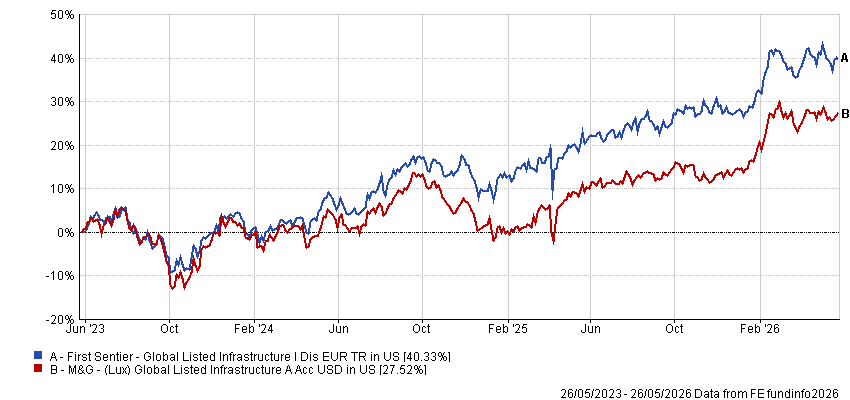
Both strategies have generated strong performances, although often in different times a circumatstances.
The First Sentier fund has achieved a 40.33% three-year cumulative return with annualised volatility of 12.70%, according to FE fundinfo. Its cumulative return over five years is 34.35%, and year-to-date it is up 9.62%
The M&G strategy has a three-year cumulative return of 27.5% with annualised volatility of 13.05%, according to FE fundinfo. Its cumulative return over five years is 20.20%, but it has outperformed the First Sentier fund so far this year, up 11.13%.
“There will always be a fair amount of correlation between the two strategies in terms of performance, but we can see the headwind M&G has faced by having an underweight to utilities in the past three years,” McDermott said.
“I would expect the M&G fund to be more of a diversifier that provides resilience in challenging periods for markets. For example, in 2020 it returned 1.3%, compared with a 5.6% loss for First Sentier,” he noted.
“Both are big teams with able support and resources,” said McDermott.
Peter Meany established the First Sentier Global Listed Infrastructure Securities strategy in 2007. With over two decades of investment experience, he joined the company in January 2007. Prior to this, Meany was a director and head of infrastructure and utilities research at Credit Suisse Equities (Australia).
He also worked as an analyst at Macquarie Equities during the early development of the private infrastructure market. He is joined on the team by co-managers Andrew Greenup and Edmund Leung.
Alex Araujo joined M&G’s equity income team in July 2015 and became co-deputy manager of the M&G Global Dividend strategy in April 2016. He has managed the M&G Global Listed Infrastructure strategy since its launch in October 2017 and took on the M&G Global Themes strategy in January 2019.
With 25 years of experience in financial markets, Araujo has previously worked at UBS and BMO Financial Group. He is joined on the fund by co-managers Nicholas Cunningham and Son Tung Nguyen.
The M&G fund has an ongoing charge of 2.08%, while the First Sentier fund charges 1.75%, according to FE fundinfo.
“There is more than one way to skin a cat within most asset classes – and that argument holds true for infrastructure,” said McDermott.
The team at First Sentier have an excellent track record of managing hard infrastructure assets. “We like their ability to target areas like management alignment, independent boards, appropriate gearing, transparent regulation and cultures that are working to sustain their license to operate,” McDermott said.
However, the M&G fund “complements a traditional infrastructure fund by focusing on areas like social, digital and royalties’ infrastructure. This has given it the opportunity to produce uncorrelated returns to the wider market”.
“We think the two can work well in combination across a full market-cycle,” McDermott concluded.
Schroders Wealth Management has hired Sharon Sim as head of business development, Asia.
This week FSA compares the First Sentier Global Listed Infrastructure fund and M&G Global Listed Infrastructure fund.
Brookfield Infrastructure income fund is available to wholesale investors in Australia’s private wealth market.