BlackRock’s Stephen Gough: Fixed income is in a ‘golden age’
Asian bonds offer attractive yields, diversification and robust credit fundamentals, BlackRock’s Stephen Gough tells FSA.


Asian bonds offer attractive yields, diversification and robust credit fundamentals, BlackRock’s Stephen Gough tells FSA.
Asian bonds offer attractive yields, diversification and robust credit fundamentals, BlackRock’s Stephen Gough tells FSA.

The new hires include three bankers in Hong Kong and three in Singapore.

The Hong Kong-based private equity firm has raised $300 million for its strategy.
The Hong Kong-based private equity firm has raised $300 million for its strategy.

Roy Gori was president and CEO of Manulife from 2017 to 2024.

Sponsored by Loomis Sayles & Natixis
The Growth Equity Strategies Team at Loomis Sayles, an affiliate of Natixis Investment Managers, demonstrates that patience, discipline and conviction result in consistent, peer-leading risk-adjusted compounding over cycles.
Asian bonds offer attractive yields, diversification and robust credit fundamentals, BlackRock’s Stephen Gough tells FSA.
The Hong Kong-based private equity firm has raised $300 million for its strategy.
Asian bonds offer attractive yields, diversification and robust credit fundamentals, BlackRock’s Stephen Gough tells FSA.
Asian bonds offer attractive yields, diversification and robust credit fundamentals, BlackRock’s Stephen Gough tells FSA.

Wealthy investors are also broadening their portfolios for long-term growth.

Europe and the UK dominated dividend distributions in the second quarter.
Europe and the UK dominated dividend distributions in the second quarter.
Wealthy investors are also broadening their portfolios for long-term growth.
Wealthy investors are also broadening their portfolios for long-term growth.
Wealthy investors are also broadening their portfolios for long-term growth.
The Hong Kong-based private equity firm has raised $300 million for its strategy.
Asian bonds offer attractive yields, diversification and robust credit fundamentals, BlackRock’s Stephen Gough tells FSA.

Depending on risk tolerance, both investment grade and high yield credit offer attractive options, Stephen Gough, managing director, head of Apac credit, BlackRock told FSA in a recent interview. In fact, at current absolute yield levels, fixed income is in a “golden age”.
In particular, “Asia fixed income offers attractive yields, diversification, and robust credit fundamentals, despite headline risks. Our strategy is positioned to capture these opportunities while remaining vigilant on duration, issuer quality, and evolving market risks,” said Gough (pictured).
Governance and key credit metrics have generally improved across the region, partly due to the default cycle of 2021–22 and tighter capital discipline. The high yield index is now predominantly double-B rated, and the investment grade index is heavily weighted to sovereigns and quasi-sovereigns. No single sector currently appears to present systemic risk, although politics in countries such as Indonesia require monitoring.
On a spread-adjusted basis, Asia investment grade provides a 20–30 basis point (bp) premium over comparable US or European credits, according to Gough. In high yield, the premium is even larger—around 150bp overall, and 50–75bp in double-Bs, adjusting for duration. This premium has supported stronger performance in Asia high yield (up 3.2% YTD) compared with European (1.3%) and US (1.5%) high yield.
“Yet, despite these attractive spreads, global investors have been slow to return—largely due to the lingering effects of the China property crisis and an outdated perception of Asia high yield as China-centric,” Gough said.
But “institutional investors are now returning for diversification, and internal allocations at BlackRock to Asia credit have tripled over the past two years,” he added.
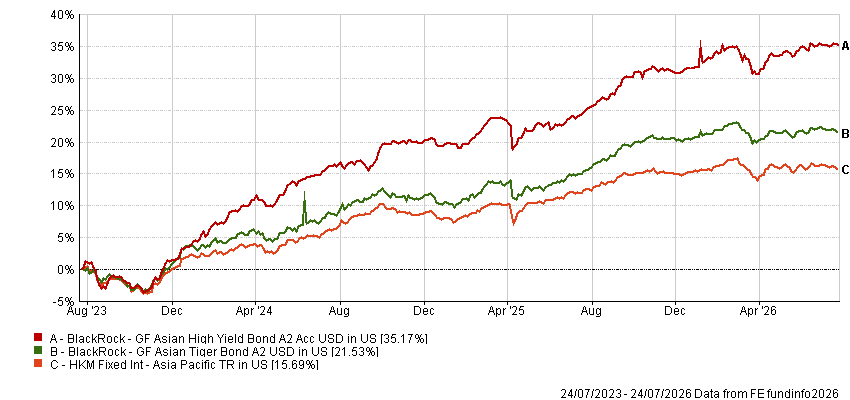
Gough manages the $1.1bn BlackRock GF Asian High Yield Bond fund, which has generated a 35.17% three-year cumulative return (to 24 July 2026), compared with a sector average (Asia fixed income funds available to Hong Kong investors) of 15.69%, according to FE fundinfo. He also manages the $2.1bn BlackRock GF Asian Tiger Bond fund, which has achieved a 21.53% three-year cumulative return during the same period.
The two fund’s annualised Sharpe ratios (a measure of risk-adjusted returns) are 1.44 and 0.69 respectively, compared with a sector average of 0.39.
Gough’s funds’ sub-investment grade allocations are yielding around 8%, “which is particularly powerful given the low-interest rate sensitivity and historically low default rates in this segment”.
“We especially favour the front end of high yield—one- to 18-month double-Bs offering 6.5–7% yields, with minimal refinancing risk, as issuers have demonstrated resilience even in challenging markets.”
Currently, the Asia high yield market is close to a double-B average rating, yet it yields more than European or US high yield, with a shorter duration of around 2.5 years—making it less sensitive to interest rates. In contrast, European and US high yield markets tend to have longer durations and tighter spreads in the double-B segment, which has contributed to their relative underperformance.
The asset class, which was once dominated by China property, has undergone significant structural change during the past six years. Much of that exposure has disappeared, leaving a more diversified benchmark, across countries, sectors, and ratings, according to Gough.
“This diversification allows active managers to navigate opportunities more effectively,” he said.
In the Asian Tiger fund, Gough is conservative on duration and has a mixture of high yield and investment grade, is overweight Australia and India, and underweight Korea for valuation reasons.
“Despite being outside the main Asia credit indices, Australian spreads are attractive on a ratings-adjusted basis, and net supply has been negative for several years, further supporting valuations,” Gough said. BlackRock especially likes AAA RMBS securitizations, which have a strong track record and offer a yield premium relative to US and Europe.
A “significant overweight exposure to India”, particularly in the renewable energy sector, is supported by favourable government policy and rising power demand, including data centre expansion. The India high yield market also benefits from positive growth rates and a supportive central bank, while the sectors involved are relatively agnostic to broader economic cycles.
Elsewhere, the Tiger fund has some exposure to Hong Kong property developers, limited allocations to Malaysia and Thailand, and is neutral on China and Macau gaming.
There are clearly risks to Asia credit, notably that a sharp correction in AI-driven equity markets could spill over into credit spreads. However, Gough actively hedges against this scenario through equities, particularly when volatility is low.
And although geopolitical risk is ever-present, BlackRock’s surveys indicate that investors are currently more concerned about the effects of geopolitics on commodity prices, inflation, interest rates, and fiscal deficits.
“Our core advice is to bring income generation back to investor portfolios, especially as the recent backup in US Treasury yields has made fixed income even more compelling,” Gough concluded.
The Hong Kong-based private equity firm has raised $300 million for its strategy.
The agreement expands MSCI’s partnership with SGX to cover global and regional equity benchmarks.

William Blair Investment Management has appointed Chandan Khanna as co-portfolio manager.