Indosuez’s Qian Su recommends alts for diversification in pro-risk stance
Head of investment management Asia, Qian Su, has also added equity hedge funds with systematic strategies in the US and Asia and also natural resources funds.

Head of investment management Asia, Qian Su, has also added equity hedge funds with systematic strategies in the US and Asia and also natural resources funds.
Head of investment management Asia, Qian Su, has also added equity hedge funds with systematic strategies in the US and Asia and also natural resources funds.

Jason Lim has been appointed head of d.istribution, South Asia ex Malaysia & Thailand
Head of investment management Asia, Qian Su, has also added equity hedge funds with systematic strategies in the US and Asia and also natural resources funds.
Head of investment management Asia, Qian Su, has also added equity hedge funds with systematic strategies in the US and Asia and also natural resources funds.

Investors increasingly see Bitcoin as a potential long-term allocation within a diversified portfolio.
Sponsored by Loomis Sayles & Natixis
The Growth Equity Strategies Team at Loomis Sayles, an affiliate of Natixis Investment Managers, demonstrates that patience, discipline and conviction result in consistent, peer-leading risk-adjusted compounding over cycles.
Head of investment management Asia, Qian Su, has also added equity hedge funds with systematic strategies in the US and Asia and also natural resources funds.
Investors increasingly see Bitcoin as a potential long-term allocation within a diversified portfolio.
Head of investment management Asia, Qian Su, has also added equity hedge funds with systematic strategies in the US and Asia and also natural resources funds.
Head of investment management Asia, Qian Su, has also added equity hedge funds with systematic strategies in the US and Asia and also natural resources funds.

Investors are beginning to distinguish between winners and losers across the technology sector, according to Man Group’s Sumant Wahi.
Investors increasingly see Bitcoin as a potential long-term allocation within a diversified portfolio.
Investors increasingly see Bitcoin as a potential long-term allocation within a diversified portfolio.

This week FSA compares the Federated Hermes Asia ex-Japan Equity fund and the Man Asia (ex Japan) fund.
This week FSA compares the Federated Hermes Asia ex-Japan Equity fund and the Man Asia (ex Japan) fund.
This week FSA compares the Federated Hermes Asia ex-Japan Equity fund and the Man Asia (ex Japan) fund.

The Baillie Gifford Enhanced Yield fund invests in short-dated government and corporate bonds.
FSA compares the CT European Select fund and the Invesco Pan European Equity fund for this week’s head-to-head.



European equities are expected to rise in the next few months as economic growth improves and cash is returned to shareholders, according to Goldman Sachs Research. The optimistic outlook is despite escalating fiscal problems in some countries, notably France and the UK, and the effect on corporate earnings from robust local currencies.
Europe’s stock market has performed well so far this year, but the outperformance is largely because of the strong euro against the US dollar.
The STOXX Europe 600 index is up 24.83% to 3 September 2025 in US dollars compared with the S&P 500 index’s 10.61%, according to FE fundinfo. However, in euros, the European benchmark index is up only 10.82% during the same period – only marginally higher than US equities.
Yet, European equities are more expensive than they were earlier in 2025. The forward price/earnings ratio—a measure of the future value of stocks—has risen to 14.4, according to Goldman Sachs. That puts European equities in the 70th percentile of their historical valuation range going back to the year 2000.
On the other hand, European stocks are still at a discount to US equities, even when they are adjusted for sector exposure or different economic growth expectations.
Second-quarter European company earnings were in line with expectations this year, but earnings estimates for the full 2025 financial year and for 2026 are being revised lower across almost all sectors, the investment bank points out.
However, following a period of outflows between 2022 and 2024, European equity funds are receiving inflows from domestic and international investors this year. Investors are diversifying their portfolios away from US assets, driven by a declining US dollar and concerns about the high concentration and valuations of US technology stocks.
In this environment, FSA asked Darius McDermott, managing director of Chelsea Financial Services and FundCalibre, to compare two European equities strategies. He chose the CT European Select fund and the Invesco Pan European Equity Income fund.
| Columbia Threadneedle | Invesco | |
| Size | $1.59bn | $50m |
| Inception | 2012 | 2006 |
| Managers | Benjamin Moore | Oliver Collin, James Goldstone |
| Three-year cumulative return | 47.94% | 55.04% |
| Three-year annualised return | 14.74% | 15.58% |
| Three-year annualised alpha | -4.73 | 0.27 |
| Three-year annualised volatility | 19.79% | 16.97% |
| Three-year information ratio | -0.69 | 0.02 |
| FE Crown fund rating | ** | *** |
| Morningstar rating | ** | ** |
| OCF | 1.80% | 2.11% |
The CT [Columbia Threadneedle] European Select fund invests in a portfolio of predominantly large-cap European equities. Manager Ben Moore, who took on the lead role in January 2021, has maintained the distinctive process, developed over several years, that focuses on industry structure and a company’s competitive position. Firms that can defend their margins and industries with barriers to entry are preferred.
Managed by Oliver Collin and James Goldstone, the Invesco Pan European Equity Income fund aims to generate income together with long-term capital growth, through investing primarily in European equities, including the UK. The fund tries to deliver an above-average gross dividend yield
The CT European Select fund invests in a portfolio of predominantly large-cap European equities. Manager Ben Moore, who took on the lead role in January 2021, has maintained the distinctive process, developed over several years, that focuses on industry structure and a company’s competitive position. Firms that can defend their margins and industries with barriers to entry are preferred.
Managed by Oliver Collin and James Goldstone, the Invesco Pan European Equity Income fund aims to generate income together with long-term capital growth, through investing primarily in European equities, including the UK. The fund tries to deliver an above-average gross dividend yield.
Turning to the CT strategy first, its “investment philosophy is based on the premise that a company’s intrinsic value is determined by its growth, returns on capital, sustainable competitive advantage and pricing power,” said McDermott.
“This approach aims to develop a thorough understanding of the industry in which a firm operates, the competitive landscape that the firm is facing and the actions it is taking to improve its positioning.”
The key inputs to idea generation are thematic, sector and macroeconomic views, company meetings and external research. Companies likely to show the most promise will exhibit some or all of the following characteristics: there has been a material corporate event, the company is under-researched in the broking community, consensus forecasts appear inaccurate, or the company fits the team’s current economic, thematic or credit views.
Supported by the European team, Moore “avoids industries with regulatory uncertainty, such as banks or telecom companies and will sometimes invest in stocks without pricing power, but only if the firm is the lowest-cost producer in the industry,” said McDermott.
The final portfolio is concentrated, with almost 50% typically held in its top 10 holdings.
The core of the Invesco team’s investment philosophy is a belief in valuation-driven, active management. “The European equities team firmly believes that investors are best served by a focus on long-term investing, avoiding an over-emphasis on current trends and consensus,” McDermott said.
Companies operate in long-term cycles and so does the focus of the investment team’s research.
“The team’s approach is to take advantage of inefficiencies in the market and buy stocks at prices below what they believe to be their intrinsic value. The investment process is driven by fundamental stock-picking, combining both top- down and bottom-up analysis, and with a focus on valuation,” said McDermott.
Although the CT and Invesco funds focus on Europe, “they do very different things”.
“With a focus on delivering an income, the Invesco fund definitely has the stronger value focus. The CT team would not see themselves as value managers as they tend to fine tune around valuations and focus on high-quality companies,” McDermott said. “This leads them to higher-quality companies in the tech and consumer space.”
The difference is reflected in each portfolio, with the Invesco fund having its largest exposures to financials, industrials and healthcare. The need for income is also highlighted by its overweight exposure (compared with its benchmark) to utilities.
By contrast, while the CT fund also has large positions in financials and industrials, it has “meaningful overweights to both technology and consumer discretionary stocks”, while it is underweight the healthcare sector.
Both strategies have a bias towards large-cap stocks, but the CT fund is higher conviction, with a relatively small number of individual holdings, and the Invesco fund has a significant allocation to UK stocks.
Fund characteristics
Sector allocation:
| Columbia Threadneedle | Weighting (%) | Invesco | Weighting (%) |
| Financials | 24.1 | Financials | 19.8 |
| Industrials | 22.8 | Industrials | 19.5 |
| Technology | 19.6 | Healthcare | 10.6 |
| Consumer discretionary | 17.3 | Materials | 8.7 |
| Consumer staples | 5.4 | Consumer staples | 8.5 |
| Basic materials | 5.4 | Utilities | 8.2 |
| Healthcare | 3.6 | Consumer discretionary | 7.2 |
| Energy | 5.4 | ||
| Others | 9.5 |
Top 10 holdings:
| Columbia Threadneedle | Weighting % | Invesco | Weighting % |
| SAP | 8.6 | E.ON | 3.7 |
| Safran | 4.1 | Sanofi | 3.2 |
| Air Liquide | 3.7 | Banco Bilbao Vizcaya Argentaria | 3.2 |
| Siemens Aktiengesellschaft | 3.7 | Intesa Sanpaolo | 3.0 |
| Deutsche Boerse | 3.7 | Shell | 2.7 |
| ASML | 3.6 | Ryanair | 2.7 |
| Amadeus | 3.6 | BAWAG | 2.7 |
| Axa | 3.2 | Deutsche Telekom | 2.5 |
| Industria de Diseno Textil | 2.9 | Akzo Nobel | 2.5 |
| Legrand | 2.9 | Barclays | 2.5 |
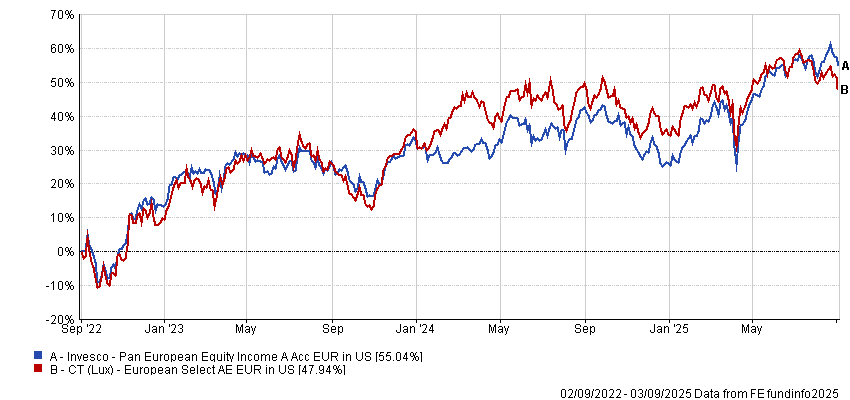
The Columbia Threadneedle fund has generated a three-year cumulative return of 47.9% in US dollar terms, according to FE fundinfo. Its annualised volatility during that period is 19.79%
“The Columbia Threadneedle strategy leans towards secular and defensive growth names, but it can suffer should growth fall out of favour,” said McDermott.
This was the case in 2022, when some of the areas the fund manager, Ben Moore, tends to avoid, performed well.
“2023 and early 2024 were kinder, with Moore pointing to certain secular trends offsetting some of the cyclical influences in markets,” McDermott said. For example, Novo Nordisk rolling out GLP-1 weight loss drugs and software company SAP’s migration to the cloud driving above trend growth.
“But growth being out of favour has been a longer-term headwind for the portfolio given the strength of the value style in the past four years,” noted McDermott.
In contrast, “value’s strength has been favourable to Invesco, particularly year-to-date”, with the fund up 24.26% (in US dollar terms), according to FE fundinfo.
The Invesco strategy has achieved a cumulative return of 55.05% during the past three years, with annualised volatility of 16.97%, FE fundinfo data shows.
However, “this fund struggles in grow-led markets, such as in 2020”, when it fell nearly one percent.
Discrete calendar year performance
| YTD* | 2024 | 2023 | 2022 | 2021 | 2020 | |
| Columbia Threadneedle | 12.49% | -0.68% | 25.32% | -27.21% | 16.33% | 18.24% |
| Invesco | 24.26% | -5.68% | 16.59% | -12.54% | 13.42% | -0.75% |
Columbia Threadneedle and Invesco are “two large asset managers with huge global footprints,” said McDermott. “Both have highly experienced portfolio managers for their European equities strategies.”
Ben Moore is a portfolio manager at Columbia Threadneedle, overseeing the European Select strategy within the European equities team. Previously, he was a European small-cap analyst and deputy portfolio manager for the European Smaller Companies strategy. Before joining Columbia Threadneedle, Moore spent six years at Goldman Sachs as an equity research analyst in the European mid-cap team.
Oliver Collin is co-head of the Invesco UK & European Equities team and leads the team’s Income and Eurozone equities portfolios. He joined Invesco in July 2014 as an analyst in the European Equities team, becoming a fund manager in December 2015.
Collins is joined by James Goldstone, is a fund manager for the UK & European equities team, managing multiple portfolios across the team’s UK Income & Growth and Pan European Equities strategies.
Prior to joining Invesco in August 2012, Goldstone was co-head of pan-European sales at Banco Espirito Santo in London. He began his career in pan-European equity sales at Credit Lyonnais in 2001 and went on, via HSBC and Dresdner Kleinwort, to specialise in UK equity sales.
The CT fund charges 1.80% for this share class, and the Invesco fund’s ongoing charges figure is more expensive at 2.11%.
“The Invesco fund has been a consistent performer in a period when value funds have had tailwinds,” said McDermott.
During the past three years it has scored relatively well over numerous metrics such as alpha and volatility. “I would say it is ideal for those investors looking for European including UK exposure with less volatility,” he said.
In contrast, “the CT fund has had a bumpier time given the challenging markets for its investment style,” noted McDermott, although a lot of the performance challenges have come in 2022 and year-to-date.
“However, the CT fund could be an ideal portfolio if we do see a style shift, given the focus on quality and stock selection,” he concluded.
This week FSA compares the Federated Hermes Asia ex-Japan Equity fund and the Man Asia (ex Japan) fund.

The case for gold is structural not cyclical, according to James Luke, lead manager of the Schroders Global Gold fund.

KBI Global Investors has launched a core sustainable strategy and a health and wellbeing strategy .